
What is mindful movement conservation?
Mindful movement conservation is about healing ourselves and our world through mindful movement. It is a creative and enlivening way of embodying our “active hope” for our living planet through mindful movement that is directly linked to compassion-based activism and conservation. It’s about making one’s practice of mindful movement as open and beneficial as possible. It’s about nourishing the field of kindness, compassion and generosity so that it is easier for others to act with kindness, compassion and generosity. It’s about holding the aspiration that one’s practice will help, heal, restore and inspire, even if the causal links are not clear. It’s about ceremony, a way of saying “yes” with your body, breath, mind and heart to love and to the emerging “Story of Interbeing.”
The Spiral of Mindful Movement1
Here are my initial thoughts on the basic structure of a mindfulness movement conservation practice.
- Express your gratitude
- Set your intention
- Move mindfully
- Dedicate the merit
- Embody your insights
- Share your story (optional)
- “Renounce and Rejoice”
Express your gratitude
Beginning with gratitude provides the foundation for the whole process. Remembering to appreciate our beautiful, living planet and the web of life that we are part of while also giving thanks for our practice and the many opportunities and blessings in our lives, puts us in the right frame of mind for our practice. Reflecting on what we are grateful for, grounds us, builds our resilience and empowers us.
“Coming from gratitude helps build a context of trust and psychological buoyancy that supports us to face difficult realities.” -Joanna Macy
“If the only prayer you ever say in your life is thank you, that will be enough.” -Meister Eckhart
Set your intention
The Tibetans have a saying: “Everything rests on the tip of motivation”. If we accept that everything rests on the tip of motivation, or intention, it makes sense that we connect with our deepest intentions, our most heartfelt motivations.
With a mindful movement conservation practice we might choose a traditional intention such as “may this practice be of benefit to all sentient beings.” It could also be a more personal intention for the healing of a specific ecosystem or the protection of a particular species of plant or animal. Regardless, the essence of our intention is that our practice be of benefit to others. Be sure to include yourself in the circle of compassion!
“The possibility for our happiness and indeed our entire spiritual journey, rests on the clarification that what most completely determines the result of any action is the motivation behind it.” –Joseph Goldstein
“When you say something with your whole being…. it can transform the world” -Thich Nhat Hanh
Move mindfully
“Mindfulness is paying attention on purpose in the present nonjudgementally” -Jon Kabat-Zinn
If you can do this while moving, you are practicing mindful movement. While vinyasa yoga is at the heart of my own personal expression of Move for Our Living Planet, you might have a different practice and way of expressing your own version of Move for Our Living Planet. Perhaps your practice is qi gong, Tai Chi, trail running, strength training, forest walking, open water swimming, or a combination of these practices. You can still follow the same basic structure, the spiral of mindful movement conservation.
My commitment for the duration of my decade-long experiment is to practice vinyasa yoga every single day as part of completing Mindful Movement Ceremonies. When I engage in other forms of mindful movement, I follow the spiral of mindful movement conservation.and directly link these Mindful Movement Ceremonies to acts of conservation.
For more on this topic, check out my key principles of vinyasa yoga, which include: Make all movements soft; Keep the dynamic quality; Practice with a very light touch; The priority is on the cultivation of mindfulness; Ride the breath; and Let go.
Dedicate the merit
“Many forms of Buddhist practice conclude with dedicating the benefit of our practice to relieving the suffering of sentient beings and helping them awaken. The English word “merit” is defined as being or doing something that is worthy and creates value. It is said that when we meditate or engage in another form of spiritual practice, such as yoga, chanting, praying, or singing songs of realization, we are accumulating merit. Dedicating this value—this wholesomeness—to all sentient beings expands our meditation beyond ourselves.” -Lama Palden Drolma (from Lion’s Roar, April 2018)
In a nutshell, dedicating the benefit of our practice makes our practice more “open and beneficial.” There are traditional and very personal ways of dedicating the merit. Find a way that works for you. Here is one example.
Embody your insights
As one practices mindful movement conservation, insights will inevitably arise. You will feel inspired to be who you are and do the work that is yours to do. Embodying the insights that arise from your practice in creative and imaginative ways to the suffering that exists in the world is an important and enlivening part of the spiral of mindful movement. My aim is that each and every Mindful Movement Ceremony I complete is directly connected to an act of conservation. This extends my practice into the world in a very tangible way.
Share your story (optional)
In this step, you have the opportunity to further extend your mindful movement practice into the world. I believe that as we mature, the personal becomes increasingly political and we become transformers of our culture. We might choose to keep our mindful movement practice very private. Alternatively, we might choose to make our practice part of a broader story or movement. We might try in creative and imaginative ways to raise awareness for a worthy cause or inspire others in some way.
“One of the ways that your project, your personal healing, or your social invention can change the world is through story. But even if no one ever learns of it, even if it is invisible to every human on Earth, it will have no less of an effect.” -Charles Eisenstein
“Compassion and understanding should be present everywhere” -Thich Nhat Hanh
“Renounce and Rejoice”
Gandhi was once asked by a western reporter to sum up his philosophy of life in 25 words or less. He said, “I can do it in three, renounce and rejoice.” This is the final step. We start with gratitude and act with good intentions. We do our best to be of benefit. After this, however, we have to give up our attachment to the result. We don’t know how it will turn out. It is impossible to perceive or predict the impact of our heart-felt actions. This is the “renounce” part. I believe the “rejoice” part is all about feeling the joy of embodying one’s “active hope” for the world, of living a life of creative service.
May this be of benefit. May all beings be happy and free.
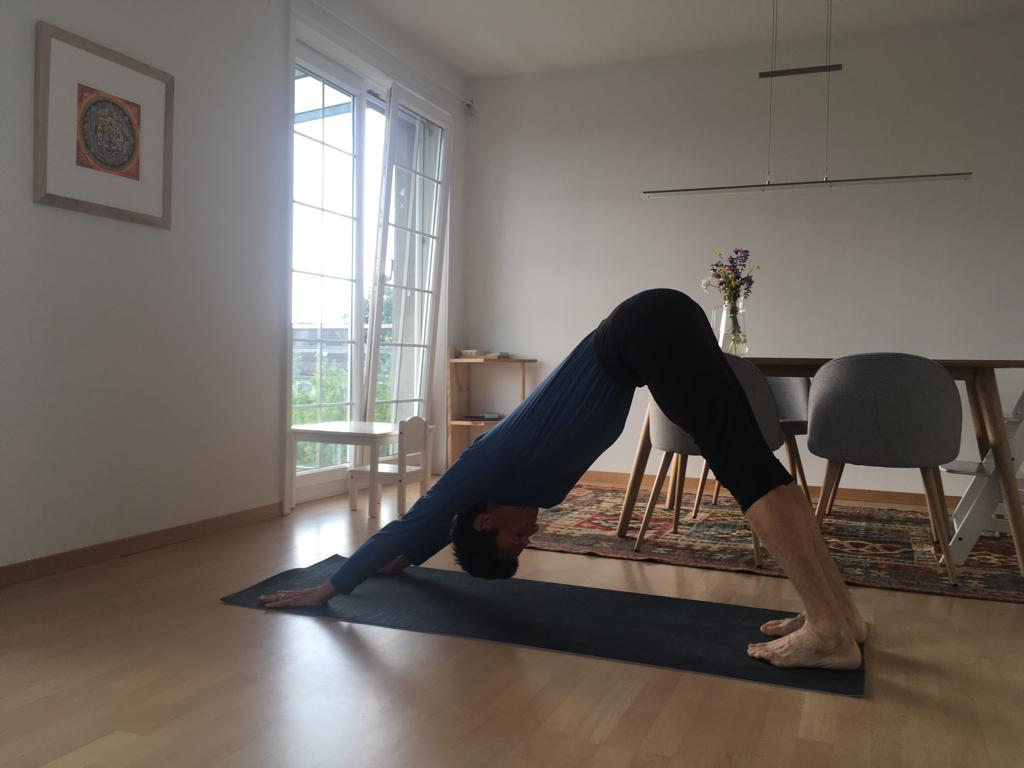
Early Morning Yoga. attitude of gratitude. photo: Erin Hannum
- Deeply inspired by “The Spiral” in Joanna Macy‘s “Work that Reconnects,” which begins with coming from gratitude, enabling us to honor our pain for the world, then seeing with new eyes, and then going forth. “In practice, each of these stages flows naturally to the next. We depict the process as an open spiral, because every journey through the process changes us. We return to Gratitude with a fresh perspective to engage with the spiral again and again.” (Adapted from Coming Back to Life, by Joanna Macy & Molly Brown). I envision the practice of Mindful Movement Conservation as an open spiral that begins with gratitude and enables an empowerment process that we engage with again and again. ↩︎
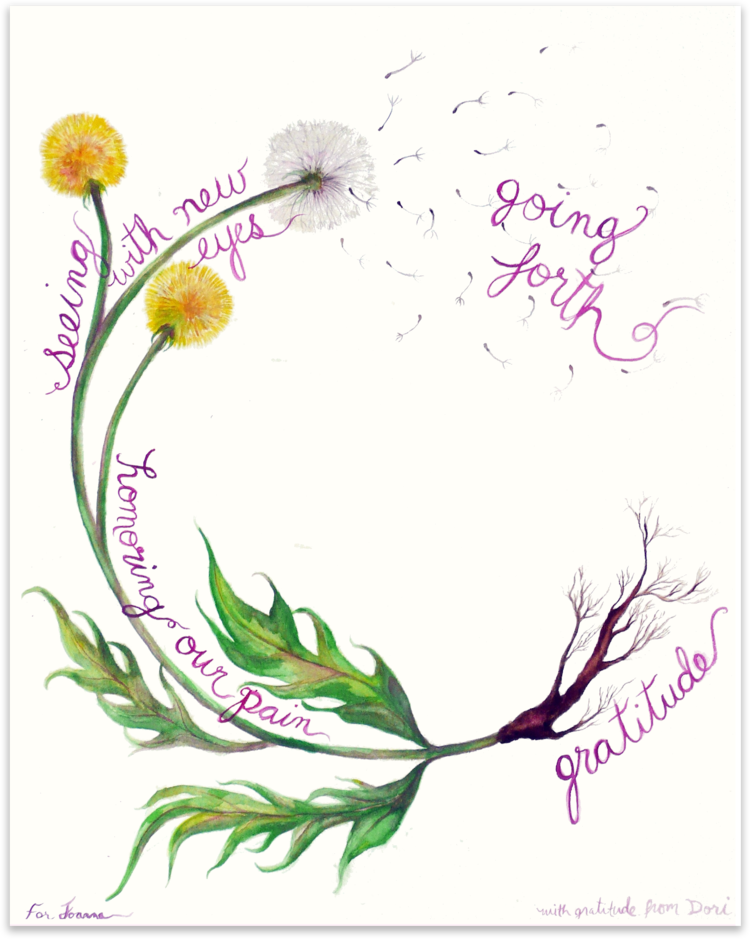
The Spiral by Dori Midnight
 Move for Our Living Planet